

The mission of the B-24 bomber Harmful Lil Armful on December 31, 1943
This mission was the last heavy bombing operation of 1943. It was an extremely difficult year for the 8th Air Force in the European Theater of Operations (ETO). A total of 23,365 B-17 bombers were deployed on missions, and 881 did not return, representing a loss rate of 3.77%. This loss rate translated to only a 38.26% chance for a B-17 bomber to complete a 25-mission tour. In the European Theater of Operations (ETO), 3,026 B-24 bombers were sent on missions, and 92 did not return, resulting in a loss rate of 3.04%. This loss rate corresponded to a 46.21% probability that a B-24 bomber would complete a 25-mission tour. These survival rates over 25 missions were never communicated to the crews, but the 8th Air Force command undoubtedly knew that achieving the required quota of 25 missions required a considerable amount of luck.
The fact that fighter escort for bomber formations was not widely employed until the last months of 1943 certainly contributed to the number of aircraft lost. Furthermore, the B-17F bomber was not equipped with a ventral nose turret, and the Luftwaffe quickly learned that frontal attacks could exploit this vulnerability with deadly efficiency. With the arrival of the American P-51 Mustang fighter, the changes in fighter tactics implemented by Lieutenant Colonel James H. Doolittle, the introduction of the B-17G bomber into fighter groups, and the loss of experienced fighter pilots by the Luftwaffe, the course of the air war in 1944 was going to be very different from that of 1943 for bomber crews and devastating for the Luftwaffe.
The mission of December 31, 1943, consisted of seven smaller formations directed primarily against various German-controlled airfields in France. The strategy appears to have been that several smaller bomber formations heading towards dispersed targets would significantly complicate Luftwaffe attempts to intercept the various streams of American bombers.
Built in Ford's manufacturing plants in the United States, the B-24H-1-FO bomber n°42-7754 named Harmful Lil Armful was powered by four Pratt & Whitney R-1830-43 engines with the following serial numbers: 42-54993, 42-64856, 42-64717 and 42-64741. Its armament consisted of Browning Type M-2 machine guns with the following serial numbers: 1149803, 218808, 1149514, 1149882, 218637, 1150091, 1149517, 1149351, 1149655, and 218381.
List of crews of the 448th Bomb Group for the mission of December 31, 1943

Operations Officer's Report of the 448th Bomb Group - Mission of December 31, 1943
The 448th Bomb Group formation composed of 3 six ship squadrons and one spare aircraft 41-29232 took off at 07:30 – 08:15. The aircraft used instruments procedure dur to darkness. Takeoff was at one minute intervals, assembling by elements at 2,000 feet northeast of the field, and then assembling with the group over Buncher 7. Wing assembly was at 3,000 feet over Buncher 7 at 08:40. The 448th Bomb Group was the lead group in the Wing.
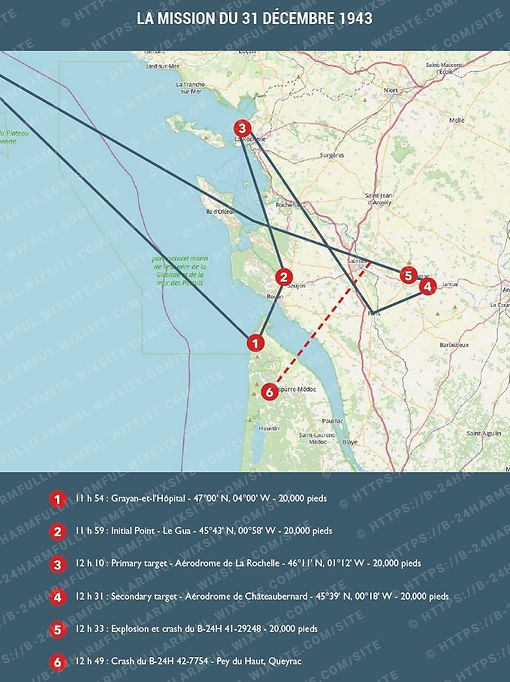
Departure from Buncher 7 was at 08:50 on schedule. The 20th Combat Wing departed from Splasher #16 in formation with the 2nd Bombardment Division at 09:21, seven minutes late. The coast was crossed at Albans Head at 10:01 at 10,000 feet. The enemy coast was crossed at the Brest peninsula at 10:39 at 15,000 feet, leaving the peninsula at 10:50. The formation proceeded on course across the Bay of Biscay, climbing at 20,000 feet and crossing the enemy coast at 11:57 at Grayan-et-l’Hôpital. The primary target of La Rochelle airport was covered by a 10/10 undercast, and it was decided to attack the secondary target of Cognac airfield.
Bombs were dropped on Cognac airfield on signal from the lead ship at 12:31. A heavy and accurate flak barrage was encountered just beyond the target. Aircraft 41-29248 was seen to be hit by flak over the target and exploded. The Group lead ship and both wing ships were heavily damaged by the first flak barrage.
The Group formation crossed the enemy coast at 12:49 and proceeded over the Bay of Biscay and Brest peninsula and crossed the English coast at 15:39 at Bournemouth. Very strong head winds in the return trip exceeding 75 MPH velocity delayed the return, and due to shortage of fuel and very bad visibility the planes sought landing fields individually after reaching England.
Aircraft 42-52132 and aircraft 42-7606 arrived at home base at 17:35 and 17:07 respectively. Aircraft 41-29232, the spare aircraft left the formation at the English coast and returned to base at 11:50. 18 aircraft proceeded to the target. Two aircraft failed to bomb the secondary target. The bomb doors and racks of aircraft 42-72981, the lead aircraft, failed to function; the bombs were jettisonned in the sea. Aircraft 42-52121 failed to bomb, reason unknown; bombs were jettisonned. Aircraft 41-29248 was seen to be hit by flask iver the target and exploded. Aircraft 42-7754 was hit by flak and shot down by an enemy aircraft.

Report by 2nd Lt. Philip Baskin of the 448th Bomb Group - Lead Navigator for the mission of December 31, 1943:
-
We took off at 07:30. We formed above the Hardwick Beacon at 2,000 feet. At 08:50 we proceeded to Splasher #16. We left Splasher #16 at 09:14 in Wing Assembly enroute for Portland Bill.
-
We crossed the English coast at 5 miles right of Anvil Point at 09:58 at 10,000 feet enroute for La Rochelle. We began passing over 07/10 to 09/10 cloud cover which made observation difficult. We had no GEE equipement. At 11 h 06 we turned toward the French coast. We were at 15,000 feet with and IAS of 160. We crossed the French coast and at 12:07 we were six miles to the right of the initial I.P. At this point a flare was fired by the radio operator.
-
The primary target was covered by a 10/10 cloud layer. The secondary target was clearly visible. The "Bombs Away" call came at 12:32 and a red flare was fired by the radio operator. We were at 20,000 feet, the I.A.S. was 160 MPH, the temperature was -22 degrees Centigrade. Our bombs were not released because of a rack malfunction. They were later jettisoned at 13:20 at 47°30' N, 03°30' W.
-
Our formation broke up over the target and when we left the French coast at 12:55 at 46°35' N, 01°50' W, there were only four ships behind us. At this time the pilot decided to follow another group which identified as the 446th Bombardment Group (H).
-
At 13:23 I called for a change of heading to cross the Brest peninsula on our briefed route. However, for protection agasint possible ennemy fighter action the pilot decided to follow the 446th Bombardment Group. At 13:45 the formation turned and when we crossed the English coast at 15:50 we were approximately forty miles west of Portland Bill. 9/10 to 10/10 cloud cover made observation difficult. At this point we were at 8,000 feet and we began to descend. The formation continued on.
-
We broke through the overcast at 1,000 feet and we decided to land at the first field we met. Flak had punctured out hydraulic lines, our gas supply was running low, our radio was dead, and weather conditions were unsuitable for safe flying. We sighted Hullavington Field at 16:15 and landed at 16:30. We returned to our own base at 14:00 on 3 january 1944.
-
Fighter cover was present over the target.
-
Flight plan and log are attached hereto.
1. Bombing approach and run : At a point six miles southeast of original I.P. for primary target, we turned and proceeded on a heading to our target. Upon reaching a point approximately 25 miles from our primary target, La Rochelle airfield, we found a cloud layer at an altitude of about 2,000 feet running east and west and extending north beyond our target and completely covering it. We decided to hit the secondary target and made a 180 degree turn and proceeded to Pons which was used as I.P. for the secondary target. A flare was fired from the lead ship when we reached the I.P. The secondary target was an airfield south of Cognac. One wave of bombers bombed this at approximately 12 h 10. Smokes from their bombs had not completely left the target as we approached. At approximately 12:27 a se cond wave of bombers hit the same target, bombing on a heading of about 100 degrees, their bombs failing to the south side of the main group of hangers at the north end of the field. Our bombing approach was made without incidence or interference. The pilot made evasive action. The length of the bombing run was approximately one minute. A flare was fired at point of bomb release. Bombs were away at 12:32. All ships dropped their bombs on release of lead ship. Flak began to hit the formation just after the bomb release, one burst hitting aircraft 41-29248 just after it had released its bombs.
2. Disposition of bombs : 18 aircraft were in the formation as it went over the target. The lead ship 42-72981 failed to drop its bombs because of a malfunction which prevented the bomb way doors from being fully opened. Aircraft 42-52121 did not drop its bombs because it did not see bombs leave the lead ship and did not see the flare at bomb release. Each of the other ships dropped ten 500 pound GP AN M43 bombs. A total of 160 bombs were thus released on the target area. All bombs were fused 1/10 second nose and 1/100 second tail. All bombs were dropped armed.
3. Type of release : All bombs dropped on the target were released through the intervolometer with minimum setting. Bombs from ship 42-72981 were dropped individually at 13:20 by releasing each shackle. Aircraft 42-52121 toggled its bombs at the same time.
Report by 2nd Lt. Castleton D. Smith of the 448th Bomb Group - Navigator for the mission of December 31, 1943:
-
A/C 42-7606 took off at 08:13, 25 minutes later than scheduled. The delay was due to an aircraft stuck in the mud ahead of our plane. Because of the delayed takeoff, we climbed to 20,000 feet and immediately headed for Hardwick Buncher to form the group. We departed Hardwick Buncher in wing formation at 08:50. The rest of the division formed between Hardwick Buncher and Splasher No. 16. We departed Splasher No. 16 at 09:21, heading for Portland Bill at 10,000 feet.
-
We departed Portland Bill at 10:01 bound for La Rochelle. We crossed the enemy coast at Minard Point at 15,000 feet at 10:30. The formation set a heading of 47°00' N, 04°00' W. We reached 47°00' N, 04°00' W at 11:10, at 15,000 feet, then changed course toward the IP. On approach to the IP, the primary target was observed to be completely obscured by 10/10 cloud cover. The secondary target was clearly visible, so we turned right and attacked it. The bombs were dropped at 12:31 on a heading of 022 degrees magnetic, IAS 160 mph, altitude 19,600 feet, temperature -20 degrees Celsius.
-
At that point, the formation broke up and we continued our return to the enemy coast on the planned heading. We crossed the enemy coast at 14:50 at Minard Point at 16,000 feet.
-
We reached the English coast at 15:39 in Bournemouth at 9,500 feet.
-
We then returned to base using Splasher #16 and #6 as well as Buncher #7 as aids.
-
A hunting cover was present at positions along our route, in accordance with the briefing.
-
With the exception of the main objective area, enemy territory was covered by an 8/10 cloud layer.
Report from 1st Lt. Arch C. Doty of the 448th Bomb Group - S-2 for the mission of December 31, 1943:
-
18 A/C were dispatched. There were no abortives. It can be assumed that all dispatched A/C bombed the secondary target of Cognac, France. Two A/C are missing, one reported hit by flak and exploded in the air, the other shot down by an FW 190, but nine parachutes were reported seen. Fourteen of the remaining sixteen A/C landed at other airfields in England, all crew members safe with two men having slight injuries. Two A/C landed safely at this field and were interrogated.
-
At 12:31 over Cognac, three Me 109 and two FW 190 fighters were seen making attacks on other A/C. The attack was mostly from three o'clock from shallow dives and hardly getting in range before they would make a left turn away. One Me 109 did a roller-coaster and at the bottom of a slow roll. Two FW 190 shot down a B-24 over the target. Two P-47 attacked the same FW 190 and shot one down in flames.
-
AA fire over the target was heavy, barrage type, accurate, with black bursts. It was also reported heavy East of the target and batteries were observed two miles South.
-
Due to the majority of our A/C landing at other fields, results of observations are not yet fully known.
The following statements concerning A/C 41-29248 missing on 31 december 1943 were taken from the Interrogation Reports of the below listed crews for the mission :
-
Capt. Jack P. Edwards - Pilot A/C 41-29234 : Saw Jordan's ship, 41-29248, hit over the target at the n°1 engine. The plane folded up and went down in flames. Believe it hit on the ground. No chutes seen.
-
2nd Lt. William P. Ferguson - Pilot A/C 41-29191 : Saw a ship hit by flak over the targer. It blew up in a few minutes.
-
1st Lt. Albert L. Northrup - Pilot A/C 42-7764 : Saw Jordan's ship, left wing came off then the tail broke off. No chutes came out of ship.
-
1st Lt. John R. Bringardner - Pilot A/C 41-28578 : Saw a B-24 explode over the target at 12:35. No chutes.
-
1st Lt. Robert W. Carroll - Pilot A/C 42-7606 : One B-24 at 12:35 broke into three pieces juste after the bomb run. Ship fell 3,000 or 4,000 feet and then broke into smaller pieces. No one was seen to bail out nor were parachutes seen to open.