The crash of the B-24 bomber Harmful Lil Armful at Queyrac
Before reaching the French coast, the B-24H Liberator 42-7754, named Harmful Lil Armful, was already experiencing its first mechanical problems when the manifold pressure of engine n°3 began to drop. Although lagging behind, the aircraft continued to follow the formation. It reached France and flew over the town of Grayan-et-l’Hôpital at approximately 11:54. The crew then proceeded toward their Initial Point (I.P.) and the city of La Rochelle to attack their primary target, the airfield at Laleu, north of the city. However, heavy cloud cover prevented them from identifying the target. The bombers of the 448th Bomb Group therefore diverted to their secondary target, Châteaubernard airfield, located south of the city of Cognac. They bombed the target at approximately 12:31. It was at that moment that two enemy fighters, a Focke-Wulf Fw 190 and a Messerschmitt Bf 109, caught up with them. Despite the presence of Allied North American P-51B Mustang fighter planes escorting and protecting them, the enemy aircraft opened fire at three o’clock (from the right side of the aircraft), causing a major fire aboard the bomber. The German fighters continued their attacks for several long minutes. The Bf 109, piloted by Unteroffizier Hermann Fellinger, was shot down at 12:50 by two pilots from the 354th Fighter Group. The American pilots were Lt-Col. Kenneth R. Martin and 2nd Lt. Richard McDondald. The enemy aircraft crashed at a place called Sainte-Marie, located in the commune of Lesparre-Médoc.
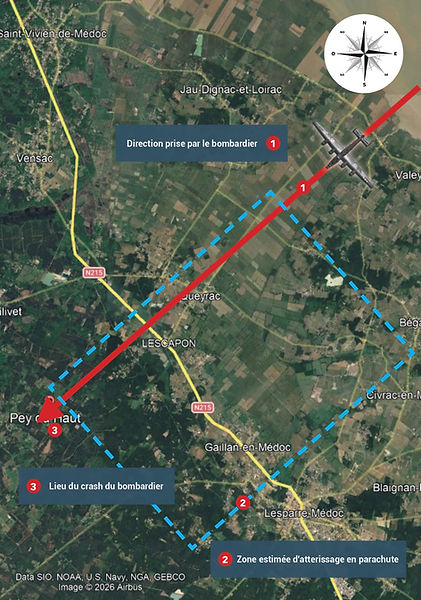
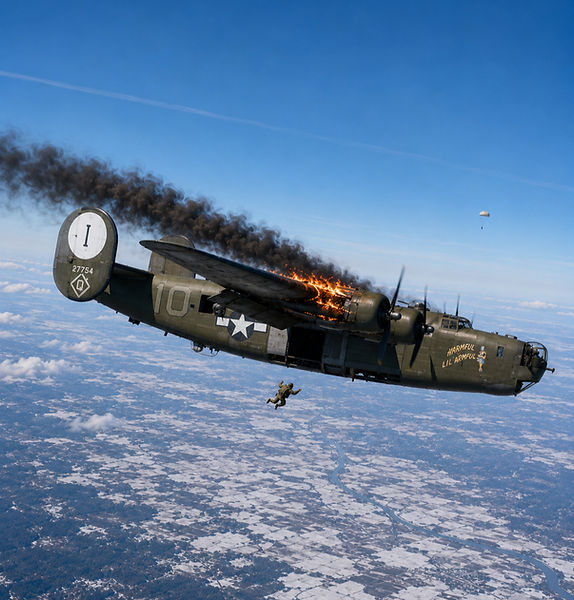
The four-engine aircraft then permanently left the formation and turned left toward the south. Engine n°3 was ablaze, and the cockpit was also on fire. The aircraft was doomed. 2nd Lt. Philip J. Chase ordered the crew to abandon the aircraft by activating the evacuation alarm. Inside the bomber, confusion and urgency prevailed. The airmen helped one another fasten their parachutes before jumping into the void without wasting a moment.
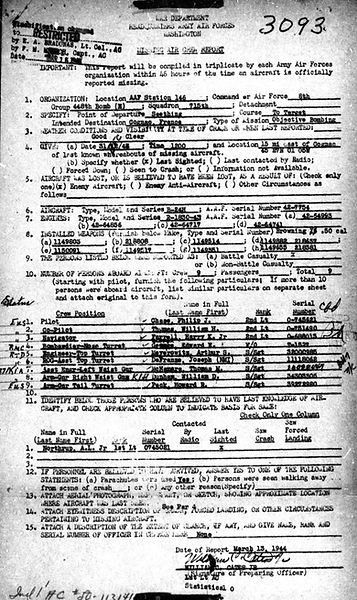
The first crew members bailed out at approximately 18,000 feet. 2nd Lt. Philip J. Chase (Pilot), 2nd Lt. William H. Thomas (Co-Pilot), S/Sgt. Joseph F. Defranze (Radio Operator), and S/Sgt. Arthur S. Meyerowitz (Flight Engineer) escaped through the bomb bay. F/O. Edward E. George (Bombardier) and 2nd Lt. Harry K. Farrell Jr. (Navigator) exited through the hatch located near the bomber’s nose wheel. S/Sgt. Howard R. Peck (Tail Gunner) escaped through the left-side window in the tail section of the aircraft. Most of the crew had bailed out within only a few minutes. Seven men were now descending through the sky, slowly making their way toward the ground beneath them.
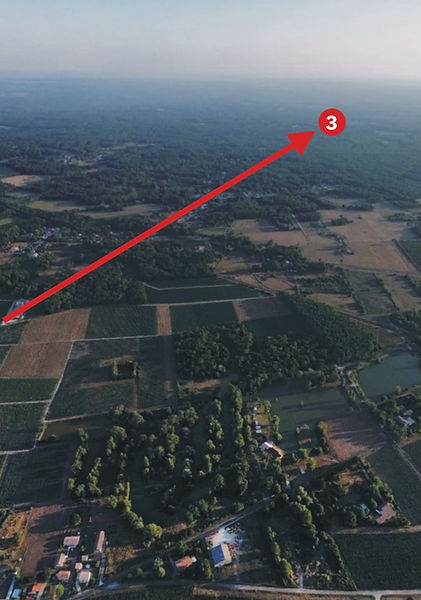
Only the two gunners, S/Sgt. Thomas M. McNamara and S/Sgt. William D. Dunham, were still aboard the stricken aircraft. According to the testimony of S/Sgt. Peck, who had jumped a few seconds earlier and was among the last members of the crew to bail out, at an altitude of approximately 12,000 feet he saw S/Sgt. McNamara still at his combat station. As Howard R. Peck’s machine gun was no longer functioning and he saw the fire spreading, he left his position and prepared to evacuate. He saw S/Sgt. McNamara remove S/Sgt. Dunham’s flak vest and help him put on his parachute harness. Approximately 30 seconds later, the bomber reportedly entered a violent spin. Both men tragically lost their lives when B-24 Harmful Lil Armful crashed at 12:49 in a field at Pey du Haut, within the commune of Queyrac. Were they afraid to jump? Did they simply run out of time? Or were they unable to escape because of the g-forces generated by the bomber’s spin? No one knows.
Probable evacuation order of the B-24 Harmful Lil Armful bomber according to the crew’s accounts:
-
Account by S/Sgt. Joseph F. DeFranze, Radio Operator of B-24H 42-7754: The flames were beginning to reach my legs, so I jumped from 15,000 feet. When the parachute opened, I was able to see the FW 190 attack our burning aircraft once again, then two parachutes emerged from the rear section of the fuselage. The aircraft was on fire and diving. Ten minutes later, I landed in a wooded area.
-
Account by 2nd Lt. Philip J. Chase, Pilot of B-24H 42-7754: All members of the crew left the aircraft at approximately the same time, unless otherwise indicated on AFPPA-11. The bombardier and navigator escaped through the nose gear hatches. The pilot, co-pilot, engineer, and radio operator went through the bomb bays. The tail gunner exited through the left side window. No information concerning the right and left waist gunners. No ball turret gunner was on board during this mission. According to his family, Philip was assisted for several hours by French civilians before being taken prisoner by German soldiers.
-
Account by 2nd Lt. William H. Thomas, Co-Pilot of B-24H 42-7754: In a report, pilot Philip J. Chase states that William H. Thomas told him that he saw Arthur S. Meyerowitz slightly burned before leaving the bomber. According to the testimony of Mrs. Michel (wife of Martial Michel), who lived in Lesparre-Médoc, he is said to have landed in the town center.
-
Account by S/Sgt. Arthur S. Meyerowitz, Flight Engineer of B-24H 42-7754: After our aircraft caught fire in the cockpit and around engine No. 3, I bailed out at an altitude of 18,000 feet, following the radio operator, pilot, and co-pilot, who had exited through the bomb bay. I did not delay my jump and, while descending, I counted three parachutes in the distance before landing in a group of trees. My parachute became caught in a tree, but I managed to free myself after removing myself from the harness. It took me only a few seconds to bury the parachute under the leaves and brush, then, thinking I could hear bicycle patrols approaching along a road, I ran through the woods toward a small village.
-
Account by 2nd Lt. Harry K. Farrell Jr., Navigator of B-24H 42-7754: I am certain that six other members evacuated the aircraft by parachute. I believe that two remained aboard the aircraft. The aircraft crashed two miles south of Lesparre.
-
Account by S/Sgt. Howard R. Peck, Tail Gunner of B-24H 42-7754: I then contacted my pilot, who told me that all six men in the nose of the aircraft had bailed out without incident. My last contact with Thomas M. McNamara and William D. Dunham was approximately 30 seconds before the aircraft began its dive. I left the aircraft at an altitude of 12,000 feet.
Account by 1st Lt. Albert L. Northrup Jr., Pilot of B-24H 42-7764: I occupied position No. 3 of the third element (high element). Lieutenant Chase was flying in position No. 2. As we approached the target area, over the Brest peninsula and east of Cognac, his aircraft was gradually falling behind the formation. Smoke was coming from his No. 3 engine, probably as a result of a Flak impact, while two Me 109s were observed making determined attacks from below. Other crews reported seeing the aircraft dive sharply, regain altitude, stall, and then dive again. When it was last seen, several parachutes (from four to nine, according to the accounts) had been observed.
On this Friday, December 31, 1943, at a place known as Pey du Haut, the weather was fine, with the sky only dotted with a few clouds, and the temperature was around 6°C. The German soldiers did not take long to arrive at the crash site, cordoned off the area, and carried out their initial inspections both on the ground and in the surrounding houses in an attempt to locate any possible airmen. In the bomber’s wreckage, they fairly quickly came across the bodies of the two gunners, Thomas M. McNamara and William D. Dunham, located beneath one of the aircraft’s wings. They took their identification tags and, a few hours later, showed them to the other American airmen captured shortly after landing, in order to obtain further information about the mission and the circumstances of the crash. In the American reports, all the prisoners would remember that these identification tags had been partially burned. Ginette, a local resident from the Pey du Haut area, remembers going to the bomber crash site with her grandfather and seeing at least one of the two airmen, deceased and partially burned, lying among the wreckage. The two American airmen were subsequently buried by the German soldiers in the Vendays cemetery, located near the crash site.
The enemy pilot credited with the destruction of this B-24H Liberator is said to have been Unteroffizier Rodwedder, of 4./Ergänzungs-Jagdgruppe Ost, which was then based at the Saint-Jean-d’Angély airfield.
Probable parachute landing area of the airmen from the B-24 Harmful Lil Armful :